REASONS TO BUY
Fortress-like strength
Two doors
Two decently sized vestibules
Good ventilation
Extremely durable
Easy to set-up
REASONS TO AVOID
Very expensive
Heavy
Bulky
Not much interior space for the weight
Small vestibule space


The Hilleberg Tarra is one of the most durable two-person tents we have ever tested. It's quick and easy to pitch and stay in place once it is set up. We've camped in 60+ mph winds that collapsed, ripped, or destroyed other 4 season models while the Tarra held strong. It's geared for expedition-use with its spacious twin vestibules and bomber 4-pole design.
The Tarra sets up from the outside. After staking out the base of the tent, the poles insert into color-coded two-foot-long sleeves, and then alternating plastic clips attach the rest of the tent to the poles. Stake out the vestibules and guylines, and you're good to go. Unlike most double-wall tents, where the poles support the inner tent, and the fly attaches on top, all Hilleberg tents have an inner tent built-in, which connects to the fly with lots of elasticized toggles. The inner tent can easily be removed and pitched by itself with an optional kit, or the outer tent can serve as a lightweight and highly durable single-wall shelter for fast and light year-round trips.
This design is superior to the traditional setup for several reasons. It's significantly easier and quicker to set up, even by yourself; there are no grommets, which also means you can keep your gloves on. Always having the fly on top protects the inner tent from rain and snow. And even if the weather is pleasant, we almost always throw the fly on too, so why not have it connected?
Another benefit of the system is that the poles stand up by themselves once inserted into the sleeves. This makes setup easier because you don't have to balance or hold one pole while you try to set up another. While this is a minor detail, it makes setup faster and much less burdensome, especially in high winds.
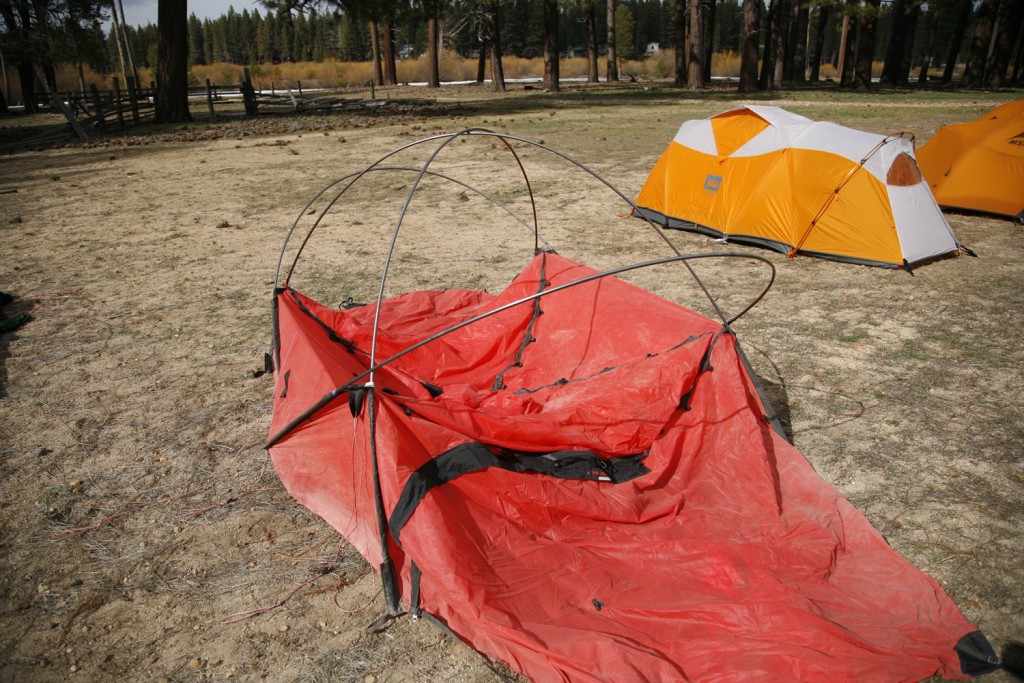
The four 10.25mm DAC Featherlite NSL green poles create a large symmetrical dome with tremendously strong sidewalls and lots of snowloading capabilities. The tent uses some of the strongest fabric found on any winter tent we've tested. Its tear strength is 40 pounds, yet weighs only 1.91 oz./yd. Each side of the fabric is impregnated with three layers of 100% silicon, a coating far superior (and more expensive) than traditional polyurethane formulations (used on most other tents from other brands). This is better because a stronger fabric is less likely to be punctured by a broken pole or to tear if punctured. A higher-quality coating is also more resistant to the sun's harmful UV rays, which will extend its waterproof capabilities for longer periods.
Another crucial detail is that the outer tent extends all the way to the ground. This reduces splashback (when rain bounces off the ground and sprays the inner tent with water and dirt) and blocks snow and wind. The adaptable pole design is another reason for the tent's superior strength. Out of the box, the Tarra is one of the strongest two-person models we've ever tested; but it can get even stronger! The short sleeve-alternating clip combination allows you to insert not one, but two poles into each sleeve and clip both poles into the tent (alternating clips allows this, see photos).
This system makes for an insanely strong tent. You can double up on the poles if you're pitching in extremely high winds. Though this tent is already robust, we feel the ability to add additional poles is a key feature (unique to Hilleberg and rarely necessary) that makes the tent worthy of being pitched nearly anywhere in the world.
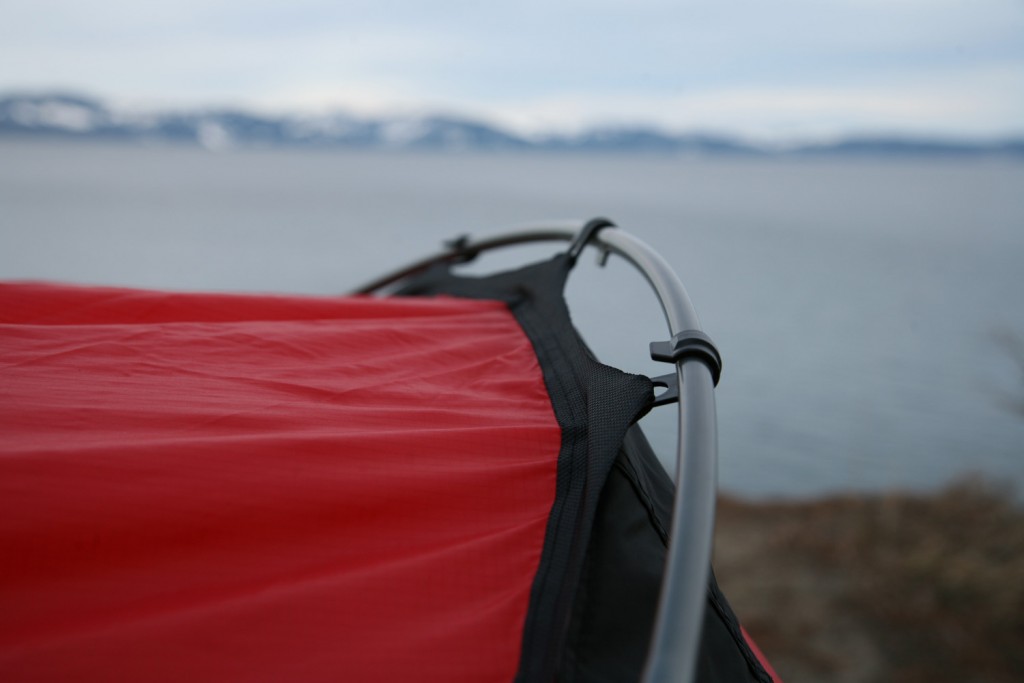
The Tarra has a myriad of smaller features that further contribute to its strength and help justify its price to specific users. Three ground straps run perpendicular to the length of the tent and serve to absorb stress during high winds, keeping the pole arcs at the proper height and tension. They can also be used as guylines if needed. It also has door bands on the bottom of the vestibule to ensure the zippers run smoothly. No other tent in our fleet has ground straps or door bands. Additionally, all guy points are reinforced, and the vestibule adjusters are made of metal, not plastic. Finally, the guylines are a Spectra-polyester blend that does not absorb water and doesn't stretch.
The fact that they don't absorb water is a small but nice bonus. Why? With 8-10 guy points and 8+ ft. of cord at each position, wet lines can make a tent significantly heavier. With no sheath to separate from the core, they're also more durable. The guylines come pre-rigged with camming adjusters so that you don't have to spend an hour cutting and attaching lines. The camming adjusters are super simple and very fast — and we must admit that we prefer them over the trucker's hitch knot.
Of all the tents we've reviewed, the only contender that is somewhat comparable to the quality of the Tarra's guylines is The North Face Mountain 25; however, the Mountain's lines are a smaller diameter and the camming adjusters are more petite. Furthermore, Tarra's guylines attach to the tent with a six-inch loop of webbing. This wraps around the pole once and transfers the majority of the tension from the stitching to the pole, yet another unique feature in this tent's bag of tricks.
Perhaps the time where this contender's exceptional strength stood out most was during a rock climbing trip to Red Rocks, Nevada. We base camped with a big group of friends on an exposed hillside location during a week of very high winds, with the wind holding steady at 20-30 mph during the day and gusting up to 70 mph at night; a serious desert storm. During a four-day period, one tent blew off into the desert only to return ravaged and irreparable.
Two collapsed, one with a broken pole, and the other with all three poles broken. Most people in the group slept poorly or not at all, or slept in their cars instead. The author and friend in the Tarra, however, were comfortable, slept well, and, thanks to the tent's solid nylon walls, were almost dust-free. During high-speed gusts, this model remained steady while other tents bellowed and buckled; it became a refuge from the storm — providing a space for reading, conversation, and games for four people.

The Tarra is more comfortable than the Hilleberg Jannu because it has more interior volume, two doors, and two large vestibules. More specifically, each vestibule is 14 sq. ft. in area - the total covered area is nearly as large as the tent's interior floor area!! All of this space is ideal for base camping or for enduring a storm, as one vestibule can provide shelter for gear, while the other serves as an entrance and cooking area (two people can fit in the door and cook together). Four large pockets and a built-in adjustable clothesline allow you stash accessories and hang wet clothes.

Ventilation is a critical component of tent design. A well-vented tent will bring in cold air below while letting hot, humid air escape from the top. The Tarra does precisely this with its large customizable top vent. There are numerous options: the inner tent has solid nylon or mesh doors, while the fly has a breathable solid nylon panel (not waterproof) above the inner tent's vent. Above that lies a sizeable waterproof cover made from the fly material.
All zippers are accessed from the inside, and the cover attaches with two toggles on one side and two hooks on the other. The hooks allow you to easily remove the vent for setup and take down (to allow access to pole clips). The vent cover is substantial in size and ties out in four places; providing ample ventilation during bad conditions. Simply put, this model has some of the best ventilation in our fleet.
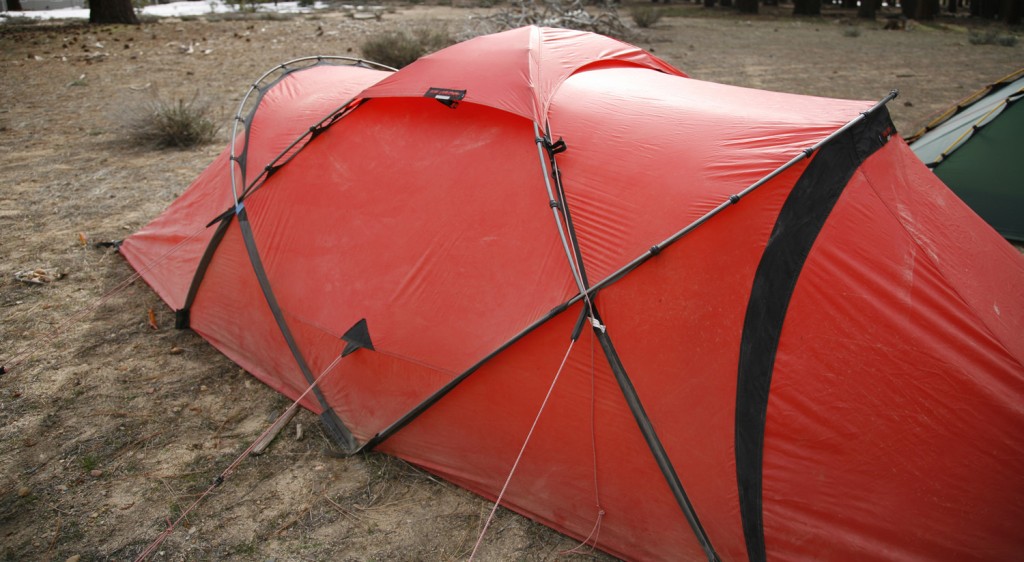
The tent is phenomenally durable; it's not that a model like The North Face Mountain 25 isn't durable, but the fabric isn't as long-lasting as the high-quality silicon impregnated Kerlon fabric.
Without the stakes, the tent weighs just a touch over nine pounds and features a packed weight of around nine pounds eight ounces. Lightweight is not why you buy the Tarra; you buy it because of its strength, durability, and spaciousness.
If you need the two doors and two vestibules and are going to be logging some time in an extreme environment, the Tarra's weight is well worth carrying. Three people slept in this tent during testing; if you opt for this route, each person will carry three pounds, which is in line with the bigger 3-4 person dome tents.
This tent is surprisingly adaptable to a wide range of conditions for an extreme weather worthy 4 season tent. It was among the higher-scoring tents for use in lower elevation 3 season backpacking trips or warm and wet alpine adventures. Hilleberg makes models that have removable inner tents, which you'll find suspend from the outer part of the tent. You can pitch the outer tent by itself to save weight at any time of the year; this is a critical feature missing from many winter tents offered by other companies.
Our favorite use of the outer tent is for summer backpacking or shorter winter trips, where weight is an important consideration and priority. The walls and vestibules extend to the ground; because of this, our testers found that the test is highly resistant to flying insects. For this floorless setup, Polycro plastic is our preferred groundsheet; it's cheap and lightweight (only four ounces for a two-person size).
Hilleberg does not use reflective cords on their zipper pulls because they find that the small and hard to grab metal pulls they use are more durable in the long-term (because cords can be pulled at different angles and may derail the zipper sliders). They report choosing not to use reflective cord for the tie outs, as they claim that none are as durable as the proprietary cord used on their tents. They also say that the reflective cord can cut through guyline attachments easier (such as a loop of cord used to extend a line).
The stuff sack for this tent is excellent. It's made of a very durable fabric and has a multi-loop handle that runs the length of the bag. The handle makes the tent easy to carry and also provides attachment points if you want to fill the bag with rocks, sand, or snow, and use it as an anchor point.
The loops can also be used to strap the tent to things such as a yak, the roof of a truck, or to a duffel bag that's attached to something else. The pole stuff sack has a hidden interior pouch that holds an extra section of pole and a large diameter splint that is subtle and well designed. No other tent manufacturer includes an extra section of pole, nor does any other tent hide it so efficiently.
Hilleberg gives you three colors to choose from: sand, green, or red. If you plan to use the tent for its ideal application, camping on snow and ice, we suggest red so you can be seen easier if you need a rescue.
The Hilleberg Tarra is by far the most expensive tent in our review. While it is a hefty chunk of change, we think its a decent value because it's one of the strongest and most durable models in our review. If you're planning to camp in the harshest of conditions for an extended period, then this tent is probably a good value even if it might be the same cost as rent in several major cities.